
Capital decisions under one roof
Fundraising, M&A, and due diligence, backed by multi-disciplinary expertise
The full service offering
Fundraising Support
See the full list →- Term sheet drafting, review, and negotiation
- Round structuring
- Investment agreement (SHA/SSA) drafting, review, and negotiation
- Liaising during investor due diligence
- Valuation report support
- Secretarial compliance
- Post-closing obligation closure
M&A Advisory
See the full list →- Buy-side advisory
- Sell-side advisory
- Deal structuring
- Tax advisory for M&A
- Transaction agreement drafting, review, and negotiation
- Slump sale, business transfer, and group consolidation advisory
Due Diligence
See the full list →- Financial due diligence
- Tax due diligence
- Legal due diligence
- Secretarial and compliance due diligence
Deal Origination
See the full list →- Buyer/seller matchmaking
- Exit strategy advisory
- Stake sale advisory
Discovery to finalisation
Discovery
Initial discussion to understand the engagement, stakes, and timeline.
Scoping
Checklist shared; scope and deliverables confirmed.
Analysis
Data review, follow-up queries, technical work.
Draft & Discussion
Draft deliverable shared; reviewed with client.
Finalisation
Post-discussion adjustments; final execution and sign-off.
What makes the work different
Multi-disciplinary group
CA, CS, CMA, and LL.B. expertise across the team, covering the financial, tax, legal, and secretarial dimensions of a transaction together.
Integrated practice across the full deal lifecycle
Valuation, due diligence, tax advisory, transaction documentation, secretarial closing, and post-closing obligations, all delivered through a single engagement. The integration is the company's most concrete operational advantage.
Engagement led by senior professionals
Senior professionals stay closely involved through the engagement.
Responsive engagement
Fluent in both founder and fund perspectives
Working with both sides of the table means the company can anticipate what each side will ask for — useful in fundraising (knowing what the fund will ask) and in M&A (knowing what the buyer or seller will push on).
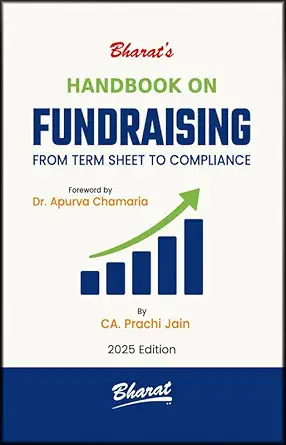
Handbook on Fundraising: From Term Sheet to Compliance
By CA Prachi Jain. A practical guide for private companies raising capital through equity shares and equity-linked securities such as CCPS and CCDs.
Read more in the Knowledge Centre →Selected engagements
USD 1.5M raise by an AI-native enterprise intelligence platform
Guided a founder through his first institutional fundraise — from data-room readiness and term-sheet negotiation to SSA/SHA and closing compliance
See full engagement →Multi-disciplinary due diligence for a Category I AIF
A SEBI-registered Category I Alternative Investment Fund needed due-diligence support across finance, tax, legal, and corporate secretarial dimensions for its prospective portfolio investments. CorpNinja ran the multi-disciplinary due-diligence programme under one coordinated engagement, covering financial, tax, legal, and secretarial due diligence for each prospective investment, with findings delivered to suit the fund's investment-committee deliberations.
See full engagement →Consolidation of a family-owned automobile business
A family-owned automobile business operating through several entities, including proprietorships, wanted to consolidate under a single corporate structure. CorpNinja advised on the consolidation and handled the incorporation of a public limited company as the consolidation vehicle, along with corporate secretarial support for the incorporation and related registrations.
See full engagement →“It has been a fabulous experience. The way the team took up this assignment and worked alongside us has been immense. I'm very pleased. I would recommend them to anyone looking for a good partner — not just for fundraising, but also for compliance, audit, and other financial needs.”
Gaurav Shinh · Founder, Scikiq
Video testimonial — hosting pending
“CorpNinja team has been a valuable asset in carrying out the due diligence — be it secretarial, legal, or financial — on the investee companies. Each aspect of the DD is looked into meticulously. The USP is the collaborative approach and willingness to go the extra mile. We have seen the team grow, and with every DD the quality of the recommendations has only raised the bar. Think DD and CorpNinja should be at your side.”
Brijesh Damodaran Nair · Founding Partner, Auxano Entrepreneur Trust
Frequently asked questions
Fundraising
A fundraising cycle involves multiple stages:
- Initial preparation — business and capital planning
- Preparing investment collateral
- Investor outreach and relationship building
- Negotiation and term sheet execution
- Due diligence
- Investment agreement execution
- Pre-funding compliances
- Funds infusion
- Post-funding compliances
Each stage takes time and builds on the previous one. Delays in one phase affect the funds infusion. The right time to start preparing is well before the company needs the money.
Investor ownership = Investment ÷ Post-money valuation
The implications are larger than they appear. The same investment amount can result in different ownership stakes depending on how the round is structured. For example:
- ₹10 crore invested at a ₹40 crore pre-money → post-money is ₹50 crore → investor gets 20%
- ₹10 crore invested at a ₹30 crore pre-money → post-money is ₹40 crore → investor gets 25%
Same investment, different outcomes.
Some of the commonly used instruments are as under:
- Equity shares — Common in early funding stages. Investors receive equity at a pre-decided valuation, with ownership, voting rights, and a share in future growth.
- Compulsorily Convertible Preference Shares (CCPS) — Combine features of preference and equity shares, converting to equity at a pre-agreed ratio at a future date or trigger event. CCPS carry liquidation preference and dividend priority over equity until conversion. They are widely used by institutional investors because they protect downside while keeping equity upside.
- Compulsorily Convertible Debentures (CCDs) — Issued as debt, but convert into equity or CCPS at a future date or event. Investors have no voting rights until conversion. CCDs are used in bridge rounds where valuation isn't yet decided. The price is not decided and discovered at conversion, via discounts, floor/cap or other mechanisms.
- Convertible Notes — Debt instruments that convert into equity at a later stage, generally at a subsequent round or milestone. Only DPIIT-recognised startups can issue them. The minimum investment is ₹25 lakh in a single tranche, and they require less compliance than CCDs.
The choice between instruments depends on the round's structure, the parties' priorities (timing of dilution, accounting treatment, investor protections), and where valuation discovery sits in the timeline. Other modes such as venture debt and revenue-based financing also exist, and customisation within the legal framework is permitted.
- Term sheet negotiation and execution — Valuation, equity stake, board composition, and investor rights are agreed and documented in a preliminary term sheet.
- Due diligence — The investor's team or external advisors review the company, which provides data and responds to queries.
- Transaction documentation — Definitive agreements are drafted, reviewed, and negotiated: Investment Agreements (such as the Share Subscription Agreement, the Shareholders Agreement), and ancillary agreements such as founder/key-employee employment agreements.
- Pre-funding compliances — Conditions precedent are closed before money flows, such as board and shareholder approvals, regulatory filings, and MOA amendments.
- Funds infusion — The investor remits the investment.
- Post-funding compliances — Securities are allotted and share certificates issued, and conditions subsequent are closed (such as ROC filings, FEMA filings such as FC-GPR for FDI, AOA amendments, and statutory register updates).
Delays at any stage can affect the timeline.
- Share Subscription Agreement (SSA) — The foundational document under which investors agree to subscribe to new shares. It covers subscription terms, conditions precedent, representations and warranties, and indemnification.
- Shareholders Agreement (SHA) — Establishes governance among shareholders post-investment, such as (a) decision-making mechanisms including affirmative vote matters, (b) pre-emptive rights, (c) transfer restrictions, (d) anti-dilution protection, (e) founders' lock-in, (f) reverse vesting, (g) liquidation preference, and (h) exit rights.
- Share Purchase Agreement (SPA) — Executed when existing shareholders sell shares to a buyer. Unlike the SSA, where new shares are issued by the company, the SPA is between existing shareholders and the buyer. It covers price, payment terms, warranties, and indemnities.
The SSA governs subscription, the SHA governs ongoing governance, and the SPA governs the sale of existing shares.
M&A
- Share sale — Sellers transfer their shares to the buyer. The company entity continues unchanged, only ownership changes. Capital gains tax applies for sellers, or business income if shares are held as stock-in-trade. Stamp duty on share transfer is currently 0.015% of consideration, lower than most other transfer modes. Under the Income-tax Act, 2025, unquoted equity shares must be transferred at a minimum value under the prescribed method; pricing below that floor can trigger tax liability.
- Slump sale — Sale of an undertaking (the whole business or a division) as a going concern for a lump sum, without assigning individual values to assets and liabilities. Tax is governed by Section 77 of the Income-tax Act, 2025 (corresponding to the erstwhile Section 50B of the Income-tax Act, 1961). Capital gains are computed on the net worth of the undertaking transferred. Under GST, transfer of a business as a going concern is exempt under Notification No. 12/2017-CTR. Suited to divisional or business-unit sales, or where the seller wants to exit a specific line without selling the entire entity.
- Itemised asset sale — Specific assets sold individually with separate valuations; each transfer is a separate tax event, and liabilities don't transfer unless specifically agreed. Gives the buyer the option to pick and choose, though the tax outcome depends on the asset mix.
The right mode depends on multiple factors such as:
- Whether the buyer wants the entire entity or only parts of it
- Tax and stamp duty efficiency for both sides
- Transferability of contracts, licences and employees
- The seller's intent (a full exit, a divisional exit, or asset monetisation)
- Merger (or amalgamation) — Two or more entities combine into one. This is governed by Sections 230–240 of the Companies Act, 2013, and requires NCLT approval along with shareholder and creditor consent. It is tax-neutral under Section 70 of the Income-tax Act, 2025 (corresponding to the erstwhile Section 47 of the Income-tax Act, 1961) if certain conditions are met. It is used to consolidate entities, eliminate duplication, or achieve scale.
- Demerger — A company splits one or more undertakings into separate entities while the original continues to exist. This is also governed by Sections 230–240, requires NCLT approval, and is tax-neutral under the Income-tax Act, 2025 if statutory conditions are satisfied. It is used to separate business lines, unlock value, prepare an undertaking for listing, or facilitate family branch separations.
- Group consolidation — A broader restructuring that reorganises multiple group entities into a cleaner ownership and operational structure, often combining mergers, demergers, share transfers, business transfer agreements, and entity conversions.
- Internal approvals — The board approval and/or the shareholder approval by ordinary or special resolution, if applicable.
- Statutory approvals — Schemes of arrangement under Sections 230–240 of the Companies Act, 2013 require NCLT sanction, granted after shareholder and creditor approvals and after statutory authorities (the Regional Director, the Official Liquidator, and the Income Tax Department) have had the chance to make representations. Other modes of transfer may require MCA filings.
- Regulatory approvals — It may include:
- The Competition Commission of India (above prescribed asset/turnover thresholds)
- The RBI/FEMA (cross-border transactions, resident–non-resident share transfers, outbound investment)
- SEBI, for listed entities (the Listing Regulations, the Takeover Code, ICDR)
- Sectoral regulators in banking, insurance, telecom, defence, broadcasting, and pharmaceuticals
- Contractual obligations — May also apply, such as lender consents or counterparty consents under change-of-control clauses.
Mapping the full approval matrix early is critical for timeline planning. Approvals often run in parallel, and a single missed one can delay or jeopardise closing.
- Separating business lines among family branches — Demergers split distinct business lines into independent entities when the next generation has different interests. This lets branches operate independently while preserving the original enterprise's heritage.
- Professionalising governance — Converting proprietorships and partnership firms into companies, followed by group consolidation, introduces formal boards, clear shareholding, and audit-ready financial systems. This is often a prerequisite for external investment or listing.
- Succession planning — Restructuring before a generational transition can reduce disputes and create clear ownership lines. This sometimes combines M&A modes with private trust structures, so family ownership passes to the next generation in a structured way while professional management runs the businesses.
- Preparing for external investment or IPO — Family businesses preparing for external investment or an IPO often need to consolidate multiple group entities into a single structure. This can combine incorporations, business transfer agreements, and charter-document amendments, all completed before the formal fundraise or DRHP filing.
The right structure depends on the family's objectives (separation, professionalisation, succession, or investment readiness) and on tax, stamp duty, and regulatory considerations.
Due diligence
- Financial due diligence — Validates the financial picture presented by the target, identifying normalisation adjustments and risks that could affect valuation or terms. Covers:
- Historical performance
- Quality of earnings
- Working capital
- Debt and contingent liabilities
- Related-party transactions
- Accounting policies
- Tax due diligence — Identifies tax exposures, whether assessed, contingent, or potential, that may affect deal value or require indemnities and escrows. Covers:
- Direct and indirect tax compliance
- Past and pending assessments
- Disputed demands
- Transfer pricing
- GST compliance
- The tax structuring of past transactions
- Legal due diligence — Identifies legal risks and verifies the target's standing. Covers:
- Corporate documents
- Material contracts
- Litigation
- IP
- Regulatory licences and approvals
- Employment matters
- Secretarial and compliance due diligence — Confirms adherence to corporate and sector-specific obligations. Covers:
- Statutory registers
- Board and shareholder records
- ROC filings
- FEMA compliance
- Sectoral regulatory compliance
Due diligence runs in two contexts:
- For buyers or investors examining a target before a decision
- For sellers or startups (vendor due diligence) pre-emptively reviewing their own company to fix gaps before the buyer's DD begins
A DD engagement runs through three stages:
- Preparation — Scope defined, information request list shared, data room opened.
- Execution — Detailed review, follow-up queries, structured clarification cycles.
- Documentation and reporting — Findings consolidated into a report, material issues flagged with assessed exposure and recommended action.
The four streams typically run in parallel and are integrated at reporting stage, so the buyer or investor gets one coherent view rather than four disjoint reports.
- Scope, methodology, and limitations — Documents what was included and excluded, the period covered, the basis of review, and any limitations, such as:
- Where only translated English versions were reviewed
- Where management representations were relied on without independent verification
- Company information — Gives the investor a well-rounded understanding, including:
- Shareholding pattern
- MOA object clause
- Key AOA clauses
- Significant board/shareholder decisions
- Securities issuance history
- Material agreements
- Financial performance
- Borrowings
- IP
- Licences with current status
- Issues identified, implications, and recommendations — The body of the report, presented as a structured table with columns for:
- Issues identified
- Implications (significance and potential impact)
- Recommendations (including whether they should be conditions precedent or subsequent)
- Management comments (any feedback provided after the draft was shared)
- Appendices — Carry supporting schedules, document extracts, regulatory references, and calculations.
A good report is a decision-support document, not just a list of issues. The structure and language should let the investor and their advisors act on the findings, not just read them.